Pages

.

Raw Jackfruit Curry Version I and reposts

P1010626
Hi everyone.
Jackfruit is a very fibrous fruit  and very good for digestion. It is native to Asia and belongs to the Mulberry family.  It is eaten both in raw and ripe form. It’s fun to work with raw Jackfruit as it absorbs flavors easily. During my recent vegetable shopping I got hold of raw Jackfruit this time. In my part of the town it’s not seen that frequently, so I did not leave the opportunity to grab this wonderful fruit which I was planning to use  for my curry. I make lot of versions with this, so this is the first version.
This particular curry is a personal favorite of mine. In this version I marinate the Jackfruit and then cook it in the spices. It’s a curry full of flavors and goes well with both rice and roti. I personally like eating this with a paratha or with hot steaming rice.
For vegetarians this  fruit is a good substitute to meat in their cooking, in fact when I served this to my younger one he asked me several times this is not non-veg no? He does not trust any one when it comes to non-veg..(knowing that we are vegetarians). I remember a few years back when we stayed in Goa, it was his first exposure to people eating non-veg. He thought, now that we are in Goa every body will eat non-veg..I had cooked chick peas and he fought with me that I had served him crab eyes …LOL. Difficult convincing the kids some times!!!
Some health facts about Jack fruit
  • Being rich in potassium, jackfruit helps in the lowering of the blood pressure.
  • The extract of Jackfruit root is believed to help cure fever as well as diarrhoea.
  • Jackfruit contains phyto nutrients, with health benefits ranging from anti-cancer to antihypertensive.
  • Jackfruit root has been found to be beneficial for those suffering from asthma.
  • The root of jackfruit is said to be good for the treatment of a number of skin problems.
  • Jackfruit has been found to have anti-ageing, antioxidant and anti-ulcer properties.

Ingredients
about 500 gm cut Jackfruit
3 large onions
3 tomatoes
6 large garlic pods
an inch of ginger
3 green chilies
oil for cooking
salt to taste
a cup of yogurt
1/4 tsp turmeric
Spices
3/4 tsp garam masala
1 tsp turmeric
2-3 tsp red chili pwd
3-4 tbsp coriander pwd
1/2 tbsp cumin pwd
3-4 bay leaves

Method
1. Oil your hands and the knife before cutting the Jackfruit as it releases sticky sap.
Marinate it with yogurt, salt and 1/4 tsp turmeric for an hour.
P1010606
2. Grind the onions and tomatoes separately and coarsely.
3. Crush together the ginger garlic and chilies.P1010605 
4. Heat oil in a pressure cooker and put the bay leaves.
P1010603
5. Put the ground onion and saute it.
P1010604 
6. Add in the crushed ginger garlic and green chilies, saute it till the raw smell disappears.
P1010611
7.  Add the ground tomatoes and mix properly and cook properly till the oil separates.
P1010612
P1010613  
8. Add in the spices and salt and saute again till a nice aroma fills in the kitchen. This indicates that the masala is nicely roasted.
P1010614
P1010615
9.  Add the marinated jackfruit to the masala and mix properly. Let the jack fruit release it’s juices. Now add about 2 cups of water and give a final stir and pressure cook it for 2 whistles.
P1010618
P1010620 
10. Once cooked, tip in some chopped cilantro and serve hot. This curry tastes best the next day surely.

P1010634
Sending this curry to Sanghi’s FIL- Fruits.

I am reposting a few recipes for ongoing events.
Semolina kheer for JFI_ Saffron hosted by DK and is the brain child of Indira.
JFI - Saffron
P1010568
and  Stuffed Oats and Wheat pancakes for Sara’s oats feast.
OATS FEAST EVENT ENDS 10TH DECP1010277
reade more... Résuméabuiyad

Avarekaalu Saaru- Another recipe with these marvelous beans

clip_image002
Hello everyone! I am posting once again my DH S’s favorite. Now you might say what’s new in that? So true, for people who read my blog regularly this is not at all a new thing. But the new thing is is that S had to really wait and pester me to make this Saaru for him. So on his birthday I treated him with this along with the Aloo Posto. What a weird combo one would say! I agree indeed, as both the recipes have extremely contradictory tastes. If the saaru is from south the Posto is from Bengal. The saaru is spicy and the posto has subtle flavors. The saaru asks for lot of coconut and the other asks for mustard… But the common thing in between both the recipes is that they taste good with hot steamed rice. Suits me!!!! Saves my time in the kitchen and the the DH gets his favoritesSmile.
This Saaru is a hot favorite in S’s family, I mean my in laws side. It frequents the kitchen when in season. When we had visited Bangalore recently my MIL had made this for lunch. I asked her the recipe that time but I forgot by the time I actually wanted to cook this. So on the D day I conveniently called up my MIL and asked her all proportions once again. She is a sweetheart and is ever ready to teach me her kind of stuff…especially when she knows it’s to pamper her son. LOL
The recipe is very simple and can be cooked very fast if the rasam podi/saaru podi is ready. It needs very basic ingredients readily available in the kitchen except for the avarekaalu/mochai/surati lilva/lima beans.

Ingredients for Rasam Powder/ Saaru Podi
Coriander seeds-3/4 cup
Bedagi Red chilies-2 cups
Cumin-1 tbsp
Mustard and Fenugreek seeds- 1/2tsp each
roast all the ingredients in a teaspoon of oil and grind together.

Ingredients for Saaru
1. 1-1/2 cups of boiled Avarekaalu
2. a cup of grated fresh coconut
3. a tsp of cumin seeds
4. 2-3 tbsp coriander seeds
5. a tbsp of tamarind pulp
6. 3-4 tbsp saaru podi
for tempering-
2 tsp oil
a tsp of mustard seeds
a sprig of curry leaves
Method
Boil the avarekaalu with some salt till cooked.
Grind together ingredients 2-6 along with 2 tbsp of boiled avarekaalu.
Mix this with the boiled avarekaalu, add water to adjust consistency and season with salt.
Put it on flame and bring it to a boil then temper it with the ingredients given under Tempering. Cook it for few more minutes and then serve it with rice and a dash of ghee.

clip_image002[1]
Sending this to MLLE-18 hosted by Srivalli and is the brainchild of Susan.
reade more... Résuméabuiyad

Aloo-Posto..a bengali delicacy, a few reposts

clip_image002Hi! When I read RV has announced the theme of Think Spice as Poppy Seeds, I knew I have a perfect entry for the same. I had made this preparation for S’s birthday in a complete jiffy but it came out so well that S mentioned to me that it’s better than what we ate in “Oh Calcutta”. For people who do not know about Oh Calcutta, let me tell you that it is one of the most renowned Bengali Restaurants.
Before I tell you the recipe let me tell you some thing more about Aloo- Posto. It is pronounced as Aloo-Poshto, is a very popular dish from West Bengal and is popularly served in marriages along with Poori/Luchhi or steamed rice.This is a dry recipe in which the potatoes are cooked in Poppy paste and has very mild flavors. I have read various versions of this preparation where people add bayleaf, panch phoron etc, but I have always preferred only Nigella seeds over them.
  I had this for the first time at a Bengali friend’s place. That time I forgot about the preparation completely and then tasted it again in “oh calcutta” which had opened in my neighbourhood in Andheri during my stay in Mumbai about 4yrs back. S who has been a big fan of Bengali food took me out for dinner there and that’s when I had aloo-posto and luchhi. To tell you truly I was not at all impressed with this preparation there and kept wondering what’s so special about it. But as you know the way to a man’s heart is through his stomach, I attempted making this at home for him and over a period of time have mastered the preparationSmile and has become one of ‘OUR FAVORITES’.
Ingredients
5-6 medium sized potatoes
4-5 tbsp poppy seeds
6-7 green chilies
1/2 tsp nigella seeds/ kalonji
1/2 tsp mustard seeds
1/8 tsp turmeric pwd
mustard oil + sunflower oil for cooking
salt to taste
clip_image002[5]
Method
Peel and wash the potatoes and cube them.
Soak poppy seeds in 1/2 glass of water for an hour. Drain the water and grind the poppy in a coffee blender ( I used my stone pestle and mortar).
Add 1/2 tsp mustard and grind it with the poppy.
Chop the green chilies and add it to the poppy paste and grind it coarsely along with it.
Heat the mix of oils and add in Nigella seeds followed by the turmeric. Put in the cubed potatoes and mix properly. Cover and cook till half done.
Put in the poppy paste, salt to taste and a glass of water. Mix properly. Cover and cook till done. The water prevents the poppy sticking to the base plus it helps the poppy to coat the potatoes properly and does not make the curry too dry.
Serve hot with steamed rice/ Pooris.
clip_image002[7]


Sending this to RV and Sunita’s  Think Spice- Think Poppy Seeds .
I am also re-posting my Okra in Poppy and Sesame and Churma Laddoo for the event.


clip_image002[10]
reade more... Résuméabuiyad

SUD OUEST Mercredi 2 décembre 2009

SCOT. La Sepanso et les associations regroupées au sein du Ceba(*) critiquent sévèrement le projet d'aménagement du territoire
Un brouillon à réviser »

Jean Mazodier et René Serrano (photo b. D.)
«Nous sommes déçus par le projet de PADD et très mobilisés pour y apporter les modifications qui s'imposent », résument Jean Mazodier, président de la Ceba qui regroupe 17 associations du bassin d'Arcachon et du Val de l'Eyre, et René Serrano, au nom de la Sepanso.
« On a salué, en son temps, le travail remarquable de l'État et sa note d'enjeux, rappellent les deux associatifs.
Aujourd'hui, nous désapprouvons les orientations qui sont prises par le Sybarval (Syndicat mixte du bassin d'Arcachon et du Val de l'Eyre), et nous tenons à le faire savoir, car ce texte doit être revu ».
Explications:
1 Ateliers et séminaires
« Nous avons demandé à participer aux différents ateliers et groupes de travail mis en place pour élaborer le projet d'aménagement et de développement durable, préfiguration du futur Scot (schéma de cohérence territoriale).
Il a fallu une forte pression pour qu'on nous accepte. Il faut reconnaître que nous avons été aidés par certains élus.
Nous avons également participé aux deux séminaires des 16 juin et 15 octobre. Nous avons, chaque fois, fait des observations orales et écrites mais n'avons pas reçu un seul mot d'observation sur nos commentaires. Le sous-préfet que nous avons longuement rencontré nous a cependant assuré que nous interviendrions lors de la consultation. Le Scot est un document fondamental, il ne doit pas être élaboré en vase clos. »
2 La population et l'eau
« Le projet, qui privilégie très clairement les aspects économiques et démographiques, va à l'encontre des exigences de l'État quant à la hiérarchisation des priorités et la prise en compte des enjeux écologiques. L'État incitait à limiter l'accroissement de la population à 35 000 habitants de plus d'ici à 2030. Avec le PADD, nous atteignons les 70 000 habitants, soit une augmentation de la population de 4 % par an, c'est de la folie.
On ne sait pas comment alimenter cette population en eau potable. Le Siba ne sera pas non plus en capacité de traiter les eaux usées. Sans parler des risques littoraux qui imposent de cesser toute urbanisation dans les zones exposées. »
3 Des campings dans la forêt
« Les coupures d'urbanisation sont menacées, notamment entre le Bassin et la Communauté urbaine de Bordeaux. La route-frontière appellera forcément l'urbanisation. Nous avons dû insister assez violemment pour que soit prise en compte la nécessité d'un transport en commun en site propre dans le nord du Bassin.
Le mot biodiversité n'apparaît pas dans la présentation du PADD qui confond toutes sortes de forêts. Enfin, la proposition de déplacer les campings du Pyla au bord du lac de Cazaux est scandaleuse, car contraire à la protection des espaces naturels. Elle entraînerait des trouées routières dans la forêt, tout aussi inadmissibles. »
4 Une réécriture indispensable
« Le PADD n'est pas cohérent avec la note d'enjeux de l'État. Il ne répond pas à l'urgence de protéger les équilibres du bassin d'Arcachon et du Val de l'Eyre, avec une protection des surfaces agricoles et naturelles, la lutte contre l'étalement urbain, la déperdition d'énergie et la gestion économe des ressources et de l'espace. Le PADD se présente comme un brouillon à corriger. Nous demandons instamment à ce qu'il soit réécrit, cette fois en concertation étroite avec les services de l'État et dans le respect de la note d'enjeux de l'État et de la loi Grenelle 1. Il est temps que la conscience environnementale soit une réalité de terrain respectueuse de nos territoires ».
Auteur : BERNADETTE DUBOURG


(*)Un collectif d'associations
La Ceba (Coordination environnement du bassin d'Arcachon)regroupe 17 associations, soit 4 000 membres, toutes en lien avec la défense et la protection de l'environnement, sur le bassin d'Arcachon et le Val de l'Eyre.

La Sepanso, qui est déjà une fédération d'associations, intervient aux côtés de la Ceba comme membre affilié.
La Ceba et la Sepanso sont déjà engagées dans de très nombreuses réflexions au sein notamment du Codev, de l'Agenda 21, des Sage, du Schéma de mise en valeur de la mer, et maintenant du Scot.
Tout intéresse la Ceba et la Ceba se sent concerné par tout : les Grenelle de l'environnement, le parc naturel marin, la charte forestière paysagère, l'hydraulique du Bassin, la loi littoral, les vases portuaires, la gestion des eaux fluviales et la qualité des eaux du Bassin, l'ostréiculture, la biodiversité, la ressource en eau, le traitement des déchets, les transports en commun...
De part son vaste champ d'intervention, selon la spécificité de chaque association membre, et ses nombreuses compétences, la Ceba s'inscrit comme un interlocuteur incontournable à la réflexion menée pour la constitution du futur schéma de cohérence territoriale qui devrait être adopté d'ici à la fin 2010.
La Ceba n'entend pas n'être que spectatrice. Non seulement, elle s'est invitée au débat, mais elle va également organiser des débats publics, en janvier et février pour « sensibiliser, informer le public et recueillir des avis ».
reade more... Résuméabuiyad

A quick to make Semolina Kheer

clip_image002[4]
Hello everyone! I am sure every body once in a while faces a problem of unexpected guests and then you have to cook something fervently. And in case your guests have given you sometime to think and cook some dessert this is surely a winner.
This kheer/pudding is very quick to cook and light to the stomach and extremely delicious. I remember the first time I made this Kheer, S was quite  pleasantly surprised. He does not have a sweet tooth but he just loved the Kheer.
Recently I had some guests who had joined us for a lunch on a weekday. As you know morning hours on a normal weekday are quite busy, completing morning chores and then entering the kitchen, but gladly my guests had asked me to to cook simple food. So I decided to make Methi Baingan Bharta, as fresh methi is available abundantly these days. I also made my savior Platform Potato Curry and some Khamang Kakdi which I will surely post some day. For the dessert I made this Kheer which we all loved and cherished.
Ingredients
1.25L milk
5-6 spoons Semolina/Rava/Sooji
1/2 can of condensed milk
5-6 tbsp Doodh masala
a handful of cashewnuts and raisins
a small spoon of clarified butter/ghee
Method
Take a pan/karahi and heat a spoon of clarified butter, put semolina and roast for a few minutes.
Gradually add in the milk stirring continuously to avoid lumps. Add in the milk completely and bring it to a boil. Simmer and cook for 10 mins.
Add the condensed milk gradually, stirring continuously. Keep scraping the bottom to avoid milk sticking to base. One can add more sugar at this step if you like that extra sweetness. Boil for a few more minutes and bring it to room temperature. The condensed milk provides the sweetness and thickness to the kheer.
Add the Doodh masala, cashewnuts and raisins.
Chill the kheer for an hour before serving.

clip_image002
Tip- Nutmeg adds a beautiful flavour to this kheer.
reade more... Résuméabuiyad

Avarekaalu Akki Rotti- Rice pancakes with Avarekaalu beans..and awards too

clip_image002[9]

Hi! I am posting a recipe again with Avarekalu. In my previous post with these beans I had posted a famous Upma/ Uppittu from Karnataka. In this post I am posting an Akki roti/ Rice roti. I have posted  another version of Akki Roti earlier also which you can check here. Along with S, I have also started enjoying these superb beans.
Normally on a Sunday if we are planning to go out I will indulge into a cooking a heavy breakfast or brunch so that the kids are satiated and do not bother us while we finish our chores. So this time we indulged ourselves into these extremely tasty Akki Rotis. These are to be finished fast after they are cooked as they turn very chewy otherwise, so in a hurry-burry I have managed to click these pics.
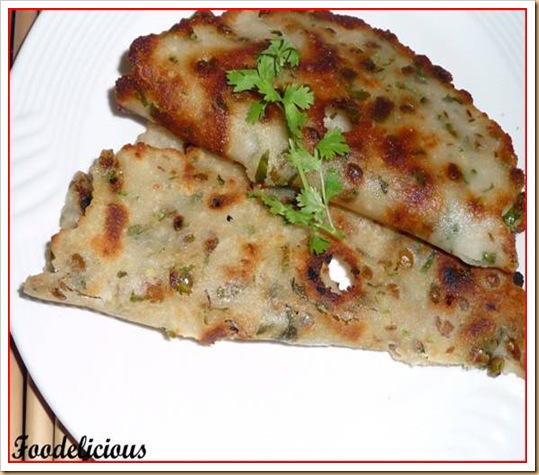
This akki roti has a flavor of the beans surely but also of the fresh coconut. It also has additional flavors of curry leaves, cilantro and is spiced with green chilies. To provide additional crispiness I added Semolina/ rava to it.
These taste best when served with butter/ghee.
Ingredients
Serves –4
2-1/2 cups rice flour(akki)
1/2 cup Semolina/ rava
1 to 1-1/2 cup  avarekalu
1 cup freshly grated coconut
8-10 green chilies chopped
2 strings curry leaves chopped
3-4 tbsp chopped cilantro
2 tsp cumin seeds
salt to taste
hot water for kneading
Method
Pressure cook the avarekalu and coconut with salt to taste else cook in water till done.
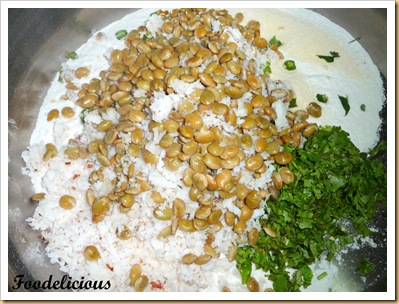
Mix the rice flour, semolina, boiled avarekalu, coconut and add all the remaining ingredients together.P1010541 P1010542 P1010545
P1010543
After mixing the ingredients form a well in the centre and put the hot water in it.
P1010546
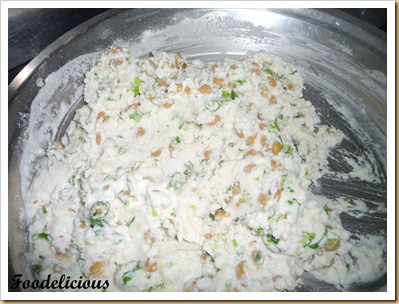
With the help of a spoon start mixing, once the temperature of the mix is tolerable to the fingers start mixing using hands. Keep adding water till every thing gets mixed properly to form a very soft dough which can spread easily.
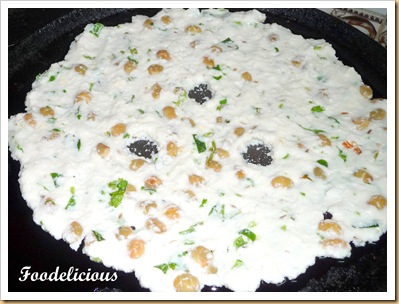
P1010547Grease a non stick pan properly with oil. Take an orange sized ball of the dough  and put it on the pan. With the help of the fingers press it and then flatten it evenly to form a round shaped roti.The thickness of the roti should be around 5-6mm. If required dip fingers in water while flattening the roti. Make hole in the centre and put a little oil. This prevents sticking of the roti in the centre.
P1010548
Now heat the pan first on high flame and once the pan is hot simmer the flame. Spread some oil on the top of the roti and then cover the roti with the lid. Once the base/ bottom part is done flip and cook the other side.
P1010549
P1010550
Once cooked on both the side serve it with some clarified butter/butter.
clip_image002[11]

Tip- If one likes sour taste can add 3-4 tbsp curds while making the dough.
I am sending this to MLLA-17 hosted by Sra at when my soup came alive and is the brainchild of Susan of The well seasoned cook
to EFM - Variety rice series  conducted by SriLekha

Priya of Priya’s recipes has passed me this and Anncoo has passed me this Thanks a lot both of you, I am truly humbled.
reade more... Résuméabuiyad

Khandeshi Style Broad Bean Curry

clip_image002
Hi everyone! Khandesh is a part of  North Maharashtra and comprises of districts like Dhule, Bhusawal, Nasik, Malegaon, Chalisgaon etc. This is largely a farming zone and the preparations made here surely have that rural touch. When I was in the middle school my mom had a  servant maid who was from Khandesh and once in a while when we needed some change of taste, we asked her to make curries. Her curries used to be hot and had that rustic taste. She would make me stand next to her and ask me to watch while she made the masala. At that point of time I always wondered with the same ingredients used how much her curry was different from ours.
When I decided to make these broad beans, I was reminded of how Alka (my mom’s maid) used to make the masala, and  I indulged myself in making a Khandeshi style masala. Since  I had seen a practical demonstration during my childhood, I had a clear idea how to head for it. This version of making the masala for the curry asks to saute all ingredients without oil and then grinding them. Now there’s surely an added flavor when the masala is ground on the stone versus that of an electric grinder. Unfortunately I do not have the stone so used the electric one, but those who have the stone, do use that.
I had sent this curry to my friend G who has been a great help to me during my illness. She is a Konkani and would pamper me with her preparations. She liked the curry a lot and  asked me how I made it and to teach her the method. So G this is for you.
About the broad beans I do not know the other name for it and are not available here, so I pick them every time I visit B’lore. These are quite popular in South and we also make Sambhar with it when these are available fresh in the season. I would be glad if you can provide me with the other names for these beans.
Coming back to the curry, it goes well with both rice and roti. So here goes the Khandeshi  version…
Ingredients
a cup of dry red broad beans
2 large onions finely chopped
4 garlic pods finely chopped
2-3 green chilies chopped
3/4 inch of ginger chopped
2 large tomatoes chopped
1 tsp cumin
1/2 tsp mustard seeds
3 tbsp dry coconut grated
1/2 tsp sugar
salt to taste
oil for cooking
3-4 tbsp chopped cilantro
Spices
2 tsp red chili pwd
3/4 tsp turmeric pwd
1/2 tsp cumin pwd
4 tsp coriander pwd
1 tsp Goda masala (Maharashtrian masala)
3 bay leaves
Method
Wash and soak the beans overnight with sufficient quantity of water. These beans absorb lot of water and expand a lot. Pressure cook them with some salt for about 10 mins on high flame and then 20 mins on low flame.
Meanwhile in a pan saute all ingredients one by one for a few minutes except the mustard, salt,cilantro, sugar and oil. Cool all the sauted ingredients and grind them together.
Heat oil and add the sugar, this gives a nice ‘tavang’. Add the mustard, followed by bay leaves.
Now add the ground paste and saute it for a few more minutes till the oil separates. Add in the spices and saute for a minute or more then add the boiled beans, do not add the water at this point.
Mix the beans and chopped coriander nicely in the masala and then gradually add the water. Bring the curry to a boil and then simmer and cook till done.
clip_image002[8]

I am sending this curry to MLLA-17 hosted by Sra at when my soup came alive and is the brainchild of Susan of The well seasoned cook
reade more... Résuméabuiyad